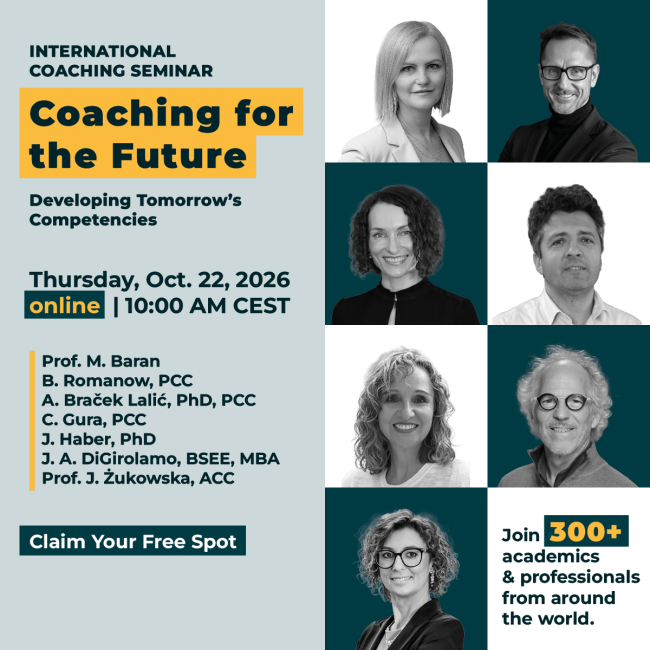
The Institute of Enterprise at SGH Warsaw School of Economics invites you to the international scientific seminar Coaching for the Future: Developing Tomorrow’s Competencies.
- 22 October 2026
- 10:00-15:30 CEST
- Online via Microsoft Teams
- Language: English
- Participation: free of charge
The seminar is implemented within the Regional Initiative of Excellence (RID) and is financed from funds of the Minister of Science and Higher Education. The event brings together academic researchers and professional coaching practitioners to explore how coaching, mentoring and leadership development can support the competencies needed by people and organisations in a rapidly changing world.
The programme combines research-based perspectives with professional coaching practice. Speakers from Poland, Slovenia, Romania and the United States will address mentoring effectiveness, human-centred coaching in the age of AI, psychological safety and future-ready leadership, transitions and organisational change, learning agility, the development of the coaching profession and research on future competencies.
The seminar is intended for researchers, academic teachers, PhD candidates, students interested in coaching, professional coaches, trainers, HR and People & Culture professionals, managers, leaders and people responsible for organisational development.
Programme
- 10:00-10:15 – Welcome and introduction
- 10:15-10:45 – Prof. Małgorzata Baran and Dr Izabela Szlaska | Civitas University, Poland
Effective Mentoring: Developing People and Organizations
Mentoring is widely recognised as an important tool for personal and professional development, but its effectiveness depends on more than simply bringing a mentor and mentee together. The presentation will examine what research tells us about effective mentoring, the qualities and competencies of successful mentors and the elements of well-designed mentoring programmes. It will also show how mentoring and coaching can complement each other in developing people, strengthening professional competencies and supporting organisational growth. - 10:45-11:15 – Bart Romanow, PCC ICF | Poland
Human-Centric Coaching for an AI-Driven World
Coaching has moved rapidly from physical rooms to digital platforms, and artificial intelligence is now reshaping the profession once again. The presentation will examine how AI and technology are changing coaching relationships, tools and the competencies leaders need in a technology-mediated environment. Drawing on executive coaching practice, the session will explore why deep human connection remains essential and how coaches can use AI as an amplifier of empathy, presence and transformational work rather than as a substitute for them. - 11:15-11:45 – Alenka Braček Lalić, PhD | Faculty of Design, Ljubljana, Slovenia
Coaching for Psychological Safety: Future-Ready Leadership
Psychological safety is increasingly recognized as a critical condition for learning, innovation and adaptability in organizations. But what role can coaching play in creating it? This presentation explores psychological safety through the lens of leadership and coaching, drawing on research and practice. - 11:45-12:15 – Claudiu Gura, PCC ICF | President, ICF Romania Chapter, Romania
Navigating Transition: Coaching, Energy and Human-Centered Systems
People often move through change before they feel ready for what comes next. This presentation looks at transition through three lenses: coaching, energy and human-centred systems. It will explore how people can find direction, use their energy more effectively and create conditions that make progress easier, as well as how coaching can strengthen confidence, capability and readiness for the future during periods of uncertainty. - 12:15-12:30 – Break
- 12:30-13:00 – Julita Haber, PhD | Associate Clinical Professor, Fordham University Gabelli School of Business, United States/
Coaching Beyond Competence: Overcoming Fear of Appearing Incompetent
As AI reshapes work, developing future competencies requires more than acquiring new skills. It also requires the willingness to enter situations in which we may not yet feel or appear competent. The presentation explores Fear of Appearing Incompetent and the competence paradox: becoming more competent often requires being willing to temporarily appear less competent. It will show how coaching can reduce image-protection behaviours and support learning agility, feedback seeking, experimentation and effective human-AI collaboration. - 13:00-13:30– Joel A. DiGirolamo, BSEE, MBA, MS IO Psychology | Vice President of Research and Data Science, International Coaching Federation, United States/
Coaching: A Profession in Transition
For decades, coaching was primarily a human-to-human activity, most often in a one-to-one relationship. Artificial intelligence, digital tools and the broader use of coaching skills are now changing that model. The presentation will explore how these developments are coming together, what they mean for coaches and clients, and what new opportunities they create for the coaching profession. - 13:30-14:30 – Speaker panel | Linking Research and Coaching Practice
The moderated panel will bring together the seminar speakers and Prof. Joanna Żukowska to connect the research and practice perspectives presented during the event. The discussion will focus on the competencies people and organisations will need in the future, the role of coaching and mentoring in their development and the questions that deserve further research. Participants will be able to submit questions through the Microsoft Teams chat. - 14:30-15:15 – Prof. Joanna Żukowska | SGH Warsaw School of Economics, Poland
How to Research Future Competencies?
This interactive workshop explores how future competencies can be studied in an international context. Participants will work with key methodological choices involved in researching competence development, including measurement tools, data sources and cross-cultural comparability. Drawing on perspectives shared during the seminar, the session will identify practical research questions and initial assumptions that could form the basis of a joint international research project on coaching, mentoring and future competencies. - 15:15-15:30 – Concluding synthesis and closing
Prof. Joanna Żukowska, Robert Strelau, Dagmara Nowicka
Speakers
Prof. Joanna Żukowska
SGH Warsaw School of Economics, Poland
Joanna Żukowska, PhD, is a Professor at SGH Warsaw School of Economics, Deputy Director of the Institute of Enterprise and Head of the Entrepreneurship and Business Environment Unit. She is an ICF-accredited coach, tutor and internationally certified trainer. Her research and professional work focus on strategic human resource management, coaching and employee competence development. She leads the postgraduate Academy of Professional Coaching and combines academic research with extensive experience in HR and coaching projects.
Prof. Małgorzata Baran
Civitas University, Poland
Małgorzata Baran is an Associate Professor of Management, Executive MBA graduate, mentor, tutor and coach. Her expertise includes human resource management, wellbeing, mentoring and sustainable development. Her research focuses on human capital development, passion at work and employee engagement. She leads business and social projects related to HRM policy and is the author of books on mentoring effectiveness and sustainable employee development.
Alenka Braček Lalić, PhD
Faculty of Design, Ljubljana, Slovenia
Dr. Alenka Braček Lalić is a leadership and organizational development expert, executive coach, and founder of the AUTHENTIC LEADERSHIP Institute. With more than 20 years of experience in leadership development, higher education, and organizational transformation, she works with executives and leadership teams to strengthen leadership effectiveness, team performance, and organizational culture. She holds a PhD in Human Resource Management and is an ICF-credentialed executive coach and Leadership Circle Profile practitioner. Alongside her consulting and coaching work, she is actively engaged in higher education, research, and international academic collaboration.
Bart Romanow, PCC ICF
Poland
Bart Romanow is a Senior L&D Expert and Executive Coach with PCC ICF accreditation and nearly 30 years of international consulting experience at the intersection of leadership development, organisational agility and future-ready competencies. He has worked with senior leaders from global organisations and European scale-ups and has more than 4,000 coaching hours and 4,000 workshop delivery hours. His work focuses on digital transformation, emotional resilience, leadership in technology-driven environments and the use of AI to amplify human potential.
Claudiu Gura, PCC ICF
President, ICF Romania Chapter, Romania
Claudiu Gura is an Enterprise Architect and ICF Professional Certified Coach who combines technology, strategy and leadership development to support people and organisations through change and transition. Active in IT and technology since 2000, he has worked across education, telecom, the public sector, defence and banking. His work focuses on innovation, business growth and the human side of transformation. He currently serves as President of the ICF Romania Chapter.
Julita Haber, PhD
Associate Clinical Professor, Fordham University Gabelli School of Business, United States
Julita Haber is an Associate Clinical Professor at Fordham University’s Gabelli School of Business, where she teaches management, leadership and organisational behaviour. Her work focuses on Fear of Appearing Incompetent, humanistic management, leadership development and workplace learning. She champions experiential and movement-integrated learning and explores approaches to developing human potential, psychological safety and meaningful leadership.
Joel A. DiGirolamo, BSEE, MBA, MS IO Psychology
Vice President of Research and Data Science, International Coaching Federation, United States
Joel DiGirolamo is Vice President of Research and Data Science at the International Coaching Federation, where he leads research on the science and profession of coaching. He has published numerous articles, book chapters and white papers on coaching research and brings more than 30 years of staff and management experience. He holds a master’s degree in industrial and organisational psychology, an MBA and a bachelor’s degree in electrical engineering, and is an Associate Editor for Consulting Psychology Journal.
Organisation
The seminar is organised by the Institute of Enterprise at SGH Warsaw School of Economics within the Regional Initiative of Excellence (RID) and is financed from funds of the Minister of Science and Higher Education.
Organising team:
Prof. Joanna Żukowska
Robert Strelau
Dagmara Nowicka