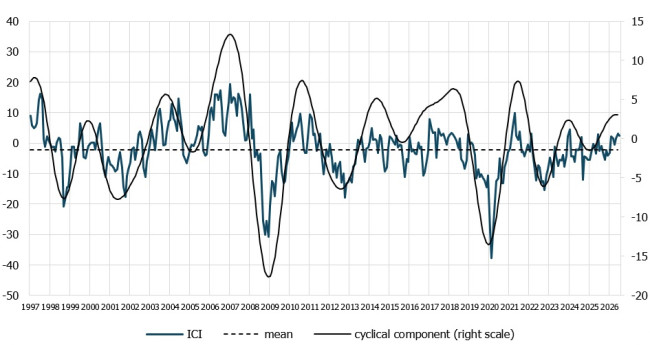
As predicted a month ago, September did not bring any significant changes in business conditions in the manufacturing sector. The value of the IRG SGH industrial confidence index (ICI) fell by 0.7 points month-over-month, to 2.5 pts. However, it remains higher than a year ago (by 4.9 pts). The decline in the IRGIND value is due to a decrease in domestic orders.
The values of most key survey balances declined. The only increases recorded were in production volume, up 1.9 pts to 3.1 points, and in the level of foreign orders, up 10.9 pts to -1.3 pts. The balance for export orders is currently as much as 20.9 pts higher than a year ago. The relatively high level of production in 2026 – the average balance for January–September 2026 is 5.7 pts higher than in the corresponding period of 2024 and 2025 and 10.3 pts higher than in January–September 2023 – is largely the result of rising foreign demand.
The balance of responses to the question about the overall situation in the Polish economy saw the sharpest decline, falling by 16.7 pts to -33.3 pts. Manufacturers assess the current overall economic situation in the country as worse than a year ago.
When broken down by major product groups, a deterioration in business conditions was recorded in the production of intermediate goods (a 4.5-pt decline in ICI) and non-durable consumer goods (a 3.4-pt decline). Business conditions improved in the production of durable consumer goods (by 24.1 pts) and capital goods (by 9.4 pts). An improvement in business conditions was recorded in each of the major product groups; the largest improvement was in the production of durable consumer goods (by 21.2 pts).
The business climate deteriorated in four macroregions: the Southwest (a decline in the index by 8.1 pts), the Northwest (by 3.2 pts), the East (by 2.8 pts), and the North (by 0.8 pts). In the remaining macroregions, the economic situation improved; the greatest improvement was in the central macroregion (by 7.5 pts). On a year-over-year basis, the economic situation deteriorated only in the western macroregions.
The forecasts of the surveyed manufacturers should be considered moderately optimistic. Overall, a slight improvement in business conditions is expected. However, there are still no signs of a sustained recovery.
Researcher:
Konrad Walczyk, kwalcz1@sgh.waw.pl